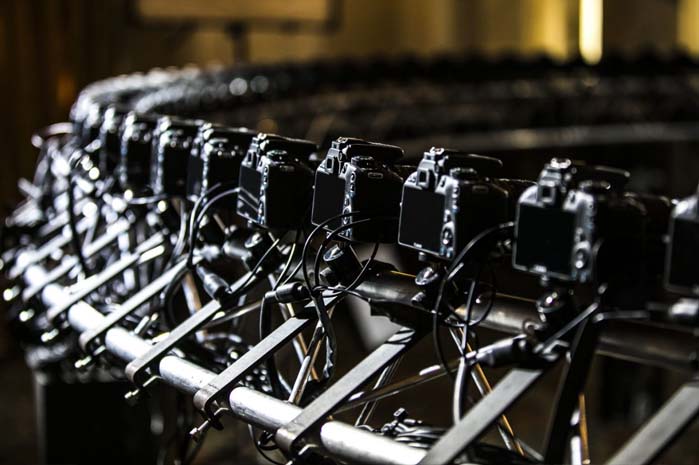
Every bullet time shot lives or dies on timing. Our trigger system is electronic, computer controlled and built by us, and it decides when every camera in the array fires, down to the millisecond.
How the Trigger System Works
A microprocessor control unit drives a chain of trigger boxes, each box firing six cameras. Every camera can be addressed individually and fired at any point in time, so a firing pattern can be anything the shot needs. Static, sequential and ramped are the common starting points, and we build custom patterns per shot on top of them. Switching from one pattern to another takes seconds on set.
The delay between cameras can be set anywhere from one millisecond to half a second and beyond, in one millisecond steps. The trigger runs as a standalone system, or linked to our bullet time software, which adds a full visual interface for plotting the firing pattern.
Static Trigger, the Classic Frozen Moment
Every camera fires at exactly the same instant, so time stops while the camera appears to keep moving around the scene. This is the traditional Matrix style bullet time shot. Lead in and lead out cameras capture the action before and after the freeze.
The static trigger in detail →
Sequential Trigger, Motion Through the Slice
Each camera fires slightly after the one before it, like a run of dominoes. A one millisecond gap between cameras reads as a thousand frames per second along the array; a longer gap slows the travel right down. The gap can be set anywhere in between, per camera.
The sequential trigger in detail →
Ramped Trigger, Full Control of Time
We plot exactly when each camera fires along a timeline. A shot can start at 30fps to match the lead in footage, slow into extreme slow motion halfway around the array, then ramp back up to real time for the lead out. The values can be set to anything the edit needs.
The ramped trigger in detail →
Lead In and Lead Out Capture
We own three Blackmagic URSA 12K cinema cameras that record the action before and after the array fires. We grade that footage and cut it onto each end of the bullet time shot, and we can work alongside any other camera on set, including Phantom high speed cameras for extra slow motion.
No Trigger at All: the Argus Rig
The trigger system belongs to our DSLR rig, where the moment is captured when the cameras fire. Our Argus Rig works the other way round: 50 cine cameras record continuous synchronised video, and the moment, speed and direction of the shot are chosen in post. If your action cannot be timed or repeated, that is usually the rig to talk about.
Talk To Us About Your Shot
If you are not sure which firing pattern your idea needs, contact us and we will work it out with you. Most briefs start as a description of the finished shot, and we build the pattern from there.